
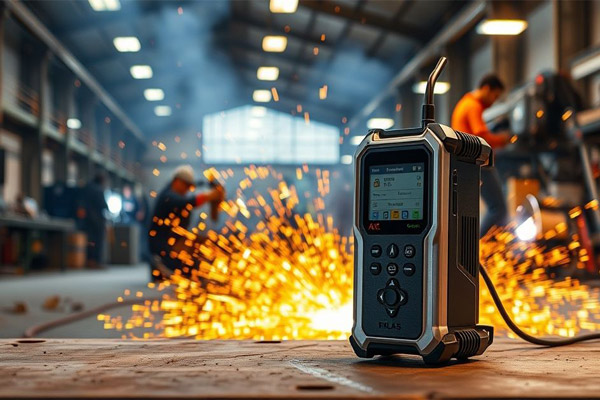
With recent changes in legislation lowering the exposure limits for welding fumes, a number of low cost particle measurement instruments have appeared on the market being promoted as real-time welding fume monitors. These optical particle counter (OPC) or dust sensor based devices are well presented and reasonably priced, making it very attractive and affordable for customers to simply buy them.
Some have phone based Apps, others use software on a PC and others boast measurements of gases and other environmental parameters all in the one low cost device. Many companies have reported buying welding fume monitors of this nature, placing them in factories, in and around welding workshops in an effort to monitor the environment and protect their staff.
The Problem
Customers need to understand what welding particulates are in order to measure them. Welding particulates typically range in size from 10nm (0.010um) or lower up to 1,000nm (1um) in size. They are not PM10 or larger as some companies believe, they are not dust, they are very small combustible aerosols which have the potential to travel over large distances, to get deep into the human lung and cause serious health problems for humans.
Welding particulates are carcinogenic and those particulates below 100nm are known as ultra-fine particles which are particularly dangerous as the World Health Organization and countless articles on the internet will support.
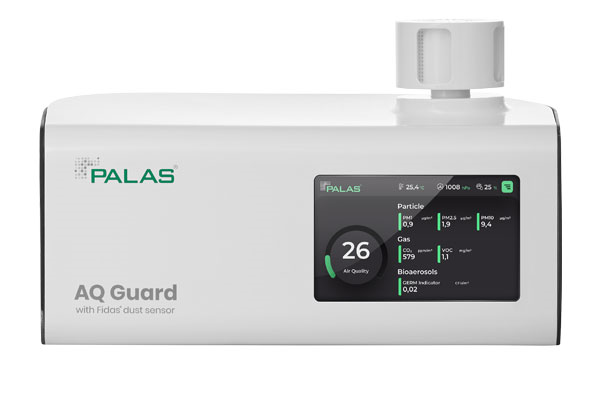
Some of these welding fume monitors have little to no technical specifications on their brochures leaving even the educated buyers wondering what it is they are really buying. Other welding fume monitors are promoted as using dust sensors or optical particle sensors with a particle size range from 0.5um to 10um or 0.3um to 10um, the typical range of an optical particle counter or low cost optical particle sensor.
The other issue is that most welders and or welding companies have little to no experience in relation to particle science and or particulate measurements. They are welders after all and likely masters of their craft.
- 0.5um is 500nm (the lower limit of some welding fume monitors)
- 0.3um is 300nm (the lower limit of some welding fume monitors)
Welding particles start from around 0.01um (10nm) up to 1um typically. A considerable number of these are below 100nm (0.1um) as stated in the 2022 AIOH Position Paper on welding fume measurements. These sub 100nm particulates are known as ultra-fine particles as discussed above.
If your welding fume monitor is unable to measure particulates below 0.5um or 0.3um, you are not only failing to to measure these potentially dangerous particles, your instrument is also going to underestimate the exposure results giving you a false sense of security.
- If your welding fume monitor only measures down to 0.3um, then you are missing out on a lot of particulates
- If your welding fume monitor only measures down to 0.5um, then you have a bigger problem
- If you have no idea what your monitor is measuring, then you have an even bigger problem again
The Solution
The solution is simple. Take your time and do your research. Don’t rush out and buy something from the internet regardless of what it is being promoted as. Don’t buy something because your friend or associate told you to. Don’t just buy anything to get your boss off your back or tick a box. Don’t copy other companies unless you trust them 100% and know they have done their research.
You can’t hope to properly measure what you don’t understand and at the end of the day, your staff’s health and well being is on the line. Understand what welding particulates are and find suitable technology to make these measurements properly.
With close to 40 years of experience in the particle measurement field, our staff at At Alpha Scientific match measurement instruments to applications. To us, there is no such thing as a welding fume monitor. These are simply dust monitors and optical particle counters being promoted as welding fume monitors.
In contrast, we offer our clients a range of measurement technologies that are capable of measuring particulates all the way down to 10nm or lower, thus properly and fully measuring welding particulates. We educate our customers and empower them to make educated choices. We discuss the pros and cons of the different options and then let our clients decide what they wish to do.
Measuring very fine particles below 300nm and certainly below 100nm or lower requires a more specialized type of instrument. A typical optical particle counter or dust monitor just wont cut it. There are then other calibration and related factors to be discussed.
While we fully understand that some companies will always be driven by price and buy products based on price, we are here for those other companies that want to do the job properly and protect their workers. Welding particulates are dangerous, the question is do you want to monitor these properly or not ?
- Click HERE to visit some of our welding fume monitoring instruments
- WHO article on Air Pollution and 6.7 million deaths annually
- WHO article on ultra-fine particles and their health effects
- AIOH 2022 Position Paper on welding Fumes (Search Google)
For more information, email sales@alphascientific.com.au or contact us on (03) 9124 9886.