
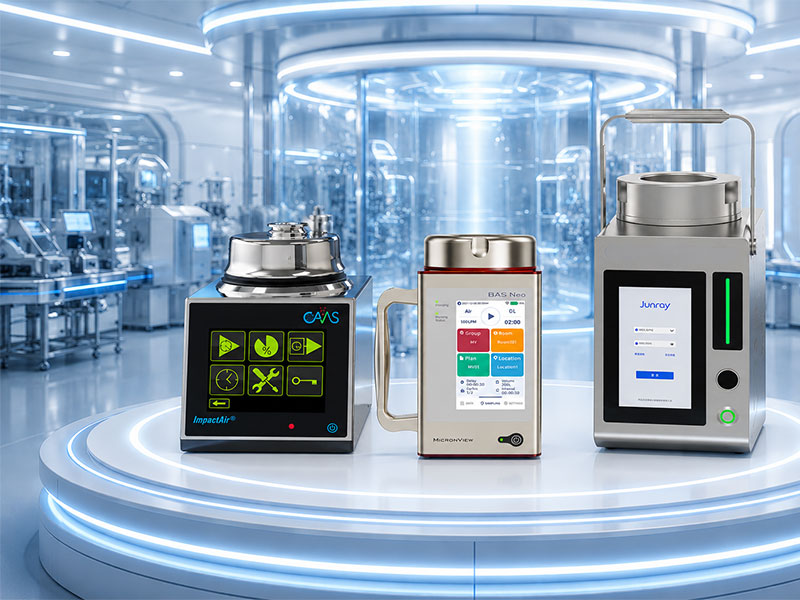
Active microbial air sampling is one of the most important components of an environmental monitoring (EM) program within pharmaceutical manufacturing, aseptic processing, biotechnology, medical device production, hospital pharmacies and other GMP regulated facilities. Significant effort is invested in selecting sampling locations, defining frequencies, establishing alert and action limits, and trending microbiological data. However, one of the most fundamental aspects of any active air sampling result is often overlooked, the accuracy of the air sampler itself.
Regardless of how sophisticated an environmental monitoring program may be, every reported result depends on one simple assumption:
The instrument has sampled the volume of air that it claims to have sampled.
If that assumption is incorrect, the microbiological result is inherently inaccurate.
Air Sampling is a Measurement of Volume
Unlike passive settle plates, active microbial air samplers are quantitative instruments. Their purpose is to draw a precisely known volume of air through a perforated sampling head and impact airborne microorganisms onto an agar plate. Following incubation, colonies are counted and reported as Colony Forming Units per cubic meter (CFU/m³).
The calculation is straightforward:
CFU/m³ = Number of Colonies Recovered ÷ Sample Volume (m³)
This means the reported microbial concentration is only as accurate as the measurement of air volume. For routine pharmaceutical monitoring, the most common sample volume is 1,000 liters (1 cubic meter), typically collected using a 100 L/min microbial air sampler over ten minutes. This has become the industry benchmark because it provides standardised data that can be compared across facilities, trends and regulatory expectations.
Small Flow Errors Create Large Measurement Errors
At first glance, a few percentage points of flow variation may appear insignificant. In reality, they directly affect every environmental monitoring result. Consider a nominal 1,000-liter sample:
| Flow Rate Accuracy | Actual Sample Volume |
|---|---|
| ±2% | 980 – 1,020 L |
| ±2.5% | 975 – 1,025 L |
| ±4% | 960 – 1,040 L |
| ±5% | 950 – 1,050 L |
A sampler operating 5% below its intended flow rate collects only 950 liters, despite the operator believing that a full cubic meter has been sampled. Conversely, a sampler operating 5% high collects 1,050 liters, increasing the exposure of the agar plate and altering the effective sampling conditions. Both situations introduce measurement uncertainty into every reported CFU/m³ result.
The Risks of Under-Sampling
Under-sampling presents perhaps the greatest concern for contamination control. If less air passes through the sampler than intended:
- fewer airborne microorganisms have the opportunity to impact onto the agar surface
- reported microbial concentrations may underestimate the true environmental bioburden
- low-level contamination events become harder to detect
- adverse trends may develop more slowly; and
- contamination investigations may be based on incomplete data
Within Grade A and Grade B cleanrooms, where microbial limits are extremely low, even small reductions in sampling efficiency can influence confidence in the monitoring program. When environmental monitoring data are used to demonstrate a state of control, accurate sample volume becomes critical.
The Risks of Over-Sampling
Collecting more air than intended is not necessarily advantageous. Sampling excessive volumes can increase:
- agar dehydration
- physical stress on collected microorganisms
- desiccation during extended sampling
- variability in microbial recovery; and
- uncertainty when comparing results with historical trends
Although modern impact samplers are designed to minimise these effects, unnecessarily increasing the sampled volume changes the sampling conditions from those originally validated by the facility. Consistency is essential for meaningful trend analysis.
Accuracy vs Stability
Many microbial air samplers are calibrated to achieve an acceptable flow rate under laboratory conditions. However, calibration alone does not guarantee that the airflow remains constant throughout the sampling cycle. During normal operation, airflow may change because of:
- battery voltage decline
- fan performance
- electronic control tolerances
- environmental pressure changes
- temperature variation
- partial blockage of the sampling head; or
- mechanical wear over time
A sampler that begins at exactly 100 L/min but gradually drifts during a ten-minute sampling cycle no longer collects exactly 1,000 liters. High-performance microbial air samplers employ closed-loop flow control, continuously monitoring and adjusting airflow throughout the sampling cycle. Rather than assuming a constant flow rate, the instrument actively compensates for operating conditions to maintain the programmed airflow and total sampled volume.
Why Improved Flow Accuracy Matters
Flow accuracy directly reduces uncertainty in environmental monitoring data. An instrument capable of maintaining airflow within ±2% or ±2.5% represents a substantial improvement over systems operating within ±4% or ±5%. The practical benefits include:
- greater confidence that a programmed 1,000-litre sample is truly 1,000 liters
- improved repeatability between operators and facilities
- more reliable long-term trend analysis
- reduced uncertainty during deviation investigations
- better comparability between sampling locations; and
- increased confidence in environmental monitoring data used for batch release decisions
For facilities implementing a comprehensive Contamination Control Strategy (CCS), reducing measurement uncertainty strengthens the overall quality of microbiological data.
Supporting Data Integrity
Current GMP expectations increasingly emphasise scientific understanding of measurement uncertainty and data reliability. Environmental monitoring data support decisions involving:
- cleanroom qualification
- aseptic process control
- contamination investigations
- process validation
- facility trending
- product release; and
- regulatory inspections
If the sampled air volume cannot be confidently verified, every downstream interpretation carries additional uncertainty. Accurate flow measurement therefore contributes directly to data integrity by ensuring that reported microbiological results genuinely represent the sampled environment.
Regulatory Perspective
Current pharmaceutical guidance documents do not specify a mandatory airflow accuracy such as ±2% or ±5%. However, they consistently require that environmental monitoring equipment be suitable for its intended use, appropriately qualified, calibrated, maintained and capable of generating reliable data. Relevant guidance includes:
- EU GMP Annex 1 – Manufacture of Sterile Medicinal Products, which requires scientifically justified environmental monitoring programs and robust contamination control strategies
- ISO 14644-1 and ISO 14644-2, which establish the framework for cleanroom classification and ongoing performance monitoring
- ISO 14698, which provides guidance on bio contamination control in cleanrooms and associated controlled environments
- USP <1116> Microbiological Control & Monitoring of Aseptic Processing Environments, which emphasises scientifically meaningful environmental monitoring rather than relying solely on numerical limits
- FDA Guidance for Industry: Sterile Drug Products Produced by Aseptic Processing, which stresses reliable environmental monitoring as part of aseptic process control
- PIC/S Guide to GMP, which aligns closely with EU GMP requirements for contamination control and environmental monitoring
Although these documents do not prescribe a specific airflow tolerance, they collectively reinforce a key principle: environmental monitoring equipment should minimise measurement uncertainty and provide reproducible, reliable data.
Precision Engineering Delivers Better Environmental Monitoring
Every active microbial air sampler performs the same basic task, drawing air across an agar plate, but not every sampler performs that task with the same level of precision. Accurate, stable flow control ensures that the intended sample volume is consistently achieved throughout every sampling cycle. This reduces uncertainty, improves confidence in CFU/m³ calculations and strengthens the overall reliability of environmental monitoring programs.
In pharmaceutical manufacturing, where microbiological data underpin contamination control strategies and product quality decisions, precision is not simply an engineering specification, it is an essential component of trustworthy environmental monitoring. When selecting a microbial air sampler, airflow accuracy should be considered alongside recovery efficiency, ease of calibration, validation support and operational reliability.
A sampler that consistently delivers the programmed sample volume provides greater confidence that every environmental monitoring result truly reflects the quality of the cleanroom environment.
For more information contact Alpha Scientific Australia wide on 1300 025 780 or email sales@alphascientific.com.au