

A portable particle counter is a battery-powered instrument that draws in air, counts airborne particles by size and reports the result against cleanroom limits, so you can monitor and certify a controlled environment wherever it is. Of all the specifications on the datasheet, flow rate is greatly important, because it decides how quickly, and how defensibly, you can sample.
Portable particle counters are built with flow rates from 2.83 L/min (0.1 CFM) up to 100 L/min (3.53 CFM). Each suits a different job, from routine spot checks in a hospital pharmacy to full ISO Class 5 certification of a pharmaceutical filling line. This guide explains how portable particle counters work, how they are used for cleanroom monitoring and certification, and how to match flow rate to your industry. It is written by Alpha Scientific, a leading Australian supplier of portable particle counters.
What is a portable particle counter?
A portable particle counter, also called a handheld or mobile airborne particle counter, is a self-contained instrument that counts and sizes particles in the air, typically from 0.1 µm to 25 µm depending on the model. It is used to verify that a cleanroom, clean zone, laminar flow cabinet or isolator meets its cleanliness class.
Unlike a remote particle counter which is commonly fixed to a wall or equipment, a portable unit goes to the sample point. One instrument can therefore serve a whole facility, which is why portable counters are the standard tool for certifiers, validation teams and quality assurance staff.
Why portable particle counters matter for cleanroom monitoring and certification
Airborne particle counts are the primary evidence that a cleanroom is doing its job, and a portable particle counter produces that evidence for two different purposes. The difference shapes which instrument you should buy.
- Certification (classification): a formal test that proves a room, zone or cabinet meets its ISO class. It is done at commissioning, after significant changes and at regular re-test intervals, usually every 6 to 12 months depending on class. A certifier samples a set number of locations at a set volume per location.
- Routine monitoring: the ongoing checks between certifications that show the room stays in control. These range from daily spot checks and post-maintenance verification to investigations after an alarm or a failed environmental sample.
Certification rewards speed and sample volume. Routine monitoring rewards size, battery life and ease of use. Many sites need both, which is why flow rate is the first question to settle.
The standards behind the numbers
| Standard | What it governs |
| ISO 14644-1:2015 | Classifying air cleanliness by particle concentration, including sample locations and sample volume |
| ISO 14644-2:2015 | The monitoring plan that shows a cleanroom continues to comply |
| ISO 21501-4 | Calibration and performance of light-scattering airborne particle counters |
| PIC/S Guide to GMP PE009-17, Annex 1 | Sterile medicine manufacture, with grade limits and sampling expectations for pharmaceutical cleanrooms |
For Australian pharmaceutical manufacturers, the last row is not optional. The TGA applies the PIC/S Guide to GMP version 17 from 1 September 2025, with a six-month transition for some of the revised Annex 1 changes (TGA). Inspectors will expect particle data that stands up to scrutiny, and that starts with a correctly specified, correctly calibrated counter.
How a portable particle counter works
A portable particle counter uses light scattering to count and size particles. An internal pump pulls air through the instrument at a controlled flow rate, and the air stream passes through a laser beam inside an optical chamber. Each particle scatters a flash of light onto a photodetector, and the height of that pulse tells the instrument how large the particle is.
The instrument sorts pulses into size channels, such as 0.3, 0.5, 1.0, 5.0 and 10 µm, and reports counts as particles per cubic meter or per cubic foot. Because the result is a concentration, two things must be accurate: the volume of air sampled and the sizing of each pulse. Both are checked during calibration to ISO 21501-4.
When comparing models, look for:
- Size channels that match your standard (0.5 µm and 5.0 µm for ISO 14644-1 and Annex 1 work)
- A stable, verifiable flow rate, because sample volume depends on it
- Low zero-count and high counting efficiency, so a clean room reads clean
- Data storage and export, with audit trails where your quality system requires them
- Battery life and weight, which decide how practical the unit is on a long certification day
Portable particle counter flow rates explained
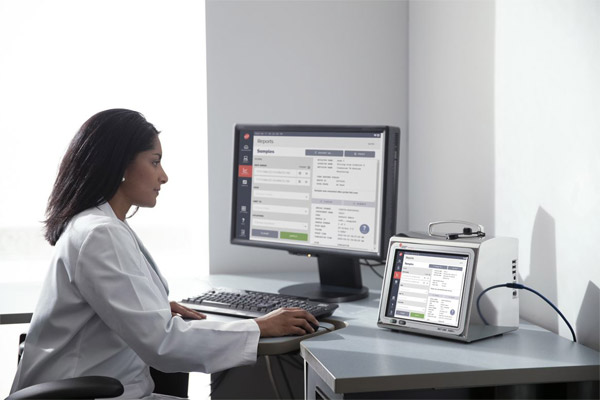
Flow rate is the volume of air a counter samples each minute, and it sets how long every test takes. Portable particle counters are commonly available at 2.83 L/min (0.1 CFM), 28.3 L/min (1.0 CFM), 50 L/min (1.77 CFM) and 100 L/min (3.53 CFM), and each has a job it does best.
Why flow rate decides sampling time
ISO 14644-1 requires enough air at each location to detect at least 20 particles if the concentration were sitting at the class limit for the largest particle size considered. The minimum single sample volume is:
V_s = \frac{20}{C_{n,m}} \times 1000
Here V_s is the sample volume in litres and C_n,m is the class limit in particles per cubic meter. The standard also sets a floor of 2 litres and 1 minute per location.
The maths shows why one flow rate does not fit every room:
- ISO Class 5 at 0.5 µm: the limit is 3,520 particles per m³, so V_s is about 5.68 L. At 2.83 L/min that is roughly 2 minutes per location.
- Grade A at 5.0 µm: the limit is 20 particles per m³, so V_s is 1,000 L. Annex 1 expects a minimum of 1 m³ per location for Grade A classification, which is where flow rate stops being a convenience and becomes a constraint.
- ISO Class 8 at 0.5 µm: the limit is 3,520,000 particles per m³, so the 2 L and 1 minute minimums apply, and any flow rate will do.
Time to sample 1 m³ at each flow rate
| Flow rate | CFM | Time to sample 1 m³ | Best suited to |
| 2.83 L/min | 0.1 | about 5 h 53 min | Routine monitoring and certification of ISO Class 6 to 9 rooms where small volumes meet the standard |
| 28.3 L/min | 1.0 | about 35 min | General-purpose certification and monitoring across ISO Class 5 to 8 |
| 50 L/min | 1.77 | 20 min | Faster certification of ISO Class 5 and Grade A/B zones |
| 100 L/min | 3.53 | 10 min | High-volume Grade A classification, large cleanrooms and busy certifiers |
A 2.83 L/min counter can still support Grade A work for short routine checks, but a full 1 m³ classification sample would take most of a working day per location. That is why higher-flow instruments dominate in pharmaceutical certification.
The trade-offs
Higher flow rates give faster, more statistically robust samples and are the sensible choice when 1 m³ volumes are required. They typically mean a larger and heavier instrument, a bigger pump and shorter battery life per charge. Lower flow rates give lighter, quieter and more affordable instruments that suit frequent walk-around checks, but they are slow wherever large volumes are needed. For unidirectional airflow, an isokinetic sampling probe should be matched to the counter’s flow rate so the sample is representative.
Choosing a flow rate for your industry
The right flow rate follows from your cleanroom class, the particle sizes you must report and how often you test. The table below is a practical starting point, not a substitute for your own sampling plan.
| Industry or application | Typical cleanliness | Common flow rate | Why |
| Sterile pharmaceutical manufacturing (fill-finish, isolators, RABS) | Grade A and B, ISO 5 at rest | 50 or 100 L/min | 1 m³ per location for Grade A classification, completed in 10 to 20 minutes |
| Pharmaceutical Grade C and D areas, gowning rooms | ISO 7 to 8 | 28.3 L/min | Fast enough for routine monitoring and requalification of larger areas |
| Hospital pharmacies and aseptic compounding | ISO 5 inside cabinets, ISO 7 background | 28.3 L/min, or 2.83 L/min for small cabinets | Short, frequent checks of cabinets and isolators |
| Medical device and implant manufacturing | ISO 7 to 8 | 28.3 L/min | A balance of speed and portability across multiple rooms |
| Semiconductor, electronics and optics | ISO 3 to 7 | 28.3 L/min or higher | Cleaner classes need large sample volumes and sensitivity to sub-micron particles |
| Laboratories, biosafety and laminar flow cabinets | ISO 5 to 7 | 28.3 L/min typically | Small work zones, short sample times and a light instrument |
| Food, beverage and packaging | ISO 7 to 9 | 2.83 or 28.3 L/min | Higher class limits, so modest volumes meet the standard |
Three questions to settle your flow rate
- What is the cleanest area you must classify? If it is Grade A or ISO Class 5 under GMP, plan around 1 m³ samples and a flow rate of 50 L/min or more.
- How many locations do you test, and how often? A large facility with dozens of locations multiplies every minute of sample time. Faster flow rates pay for themselves quickly.
- Will one instrument do certification and routine monitoring? A 28.3 L/min counter is the most common all-rounder, while many pharmaceutical sites keep a high-flow unit for certification and a smaller one for daily checks.
How to certify a cleanroom with a portable particle counter
Certification follows the same sequence whatever the industry. Doing it in order protects the validity of your results.
- Define the target. Confirm the ISO class or GMP grade, the particle sizes to report and the occupancy state, which is typically as-built, at rest or in operation.
- Plan the sample locations. ISO 14644-1:2015 sets the minimum number of locations from floor area, for example 20 locations for a room up to 156 m². Spread them evenly and add locations at critical points such as filling heads and open product.
- Calculate the sample volume and time. Apply the volume formula above, check it against the 2 L and 1 minute minimums, and divide by your counter’s flow rate to find the time per location.
- Verify the instrument. Check the calibration certificate is current, then run a zero-count test with a HEPA zero filter before you start.
- Sample at working height. Position the probe at the working level, keep it pointed into the airflow where airflow is unidirectional and keep your body clear of the sample point.
- Record and compare. Under ISO 14644-1:2015, each location is assessed against the class limit, so every location must pass for the room to pass.
- Include the standard and edition, the particle sizes, sample volumes, locations, occupancy state, counter model, serial number and calibration date.
For routine monitoring, the sampling plan comes from your contamination control strategy and risk assessment rather than a single formula. Portable particle counters then work as the flexible half of the program, used for investigations, post-maintenance checks, new-equipment qualification and gaps that fixed sensors do not cover.
How to choose a portable particle counter
Choose the portable particle counter by working back from your tightest requirement, which is usually your cleanest zone, and then check that it is practical for the rest of your work. Use this checklist when comparing models.
- Flow rate suits your cleanest class and your sample volumes (see the table above)
- Size channels cover every particle size your standard or customer requires
- Calibration is to ISO 21501-4, with a certificate you can show an auditor
- Counting efficiency and zero count meet the specification for your cleanest areas
- Data integrity features such as user log-in, audit trails and secure export, if you work under GMP
- Software and reporting that turn raw counts into a certification report quickly
- Ergonomics, including weight, screen visibility, battery life and carry case
- Probes and accessories, such as isokinetic probes, tubing, zero filters and printers
- Local support, meaning Australian calibration, servicing and technical support
The last point is easy to underestimate. A portable particle counter that is out of service for weeks while it is away for annual calibration can stall a certification schedule or a batch release.
Calibration, servicing and data integrity
A particle count is only as trustworthy as the instrument behind it. Portable particle counters should be calibrated to ISO 21501-4 at regular intervals, typically every 12 months, and after any repair or event that could affect the optics or flow. Calibration checks the sizing response, counting efficiency, flow rate and zero count, and the certificate becomes part of every certification report you issue.
Between calibrations, good habits protect your data:
- Run a zero-count check before each session
- Check flow rate regularly with a calibrated flow meter
- Keep the inlet capped and the instrument clean and dry when not in use
- Log the instrument serial number and calibration due date against every test
Where your quality system follows GMP, data integrity counts as much as accuracy. Choose a counter and software combination that records who ran a test, when, with what settings, and that stops results being edited after the fact.
Portable particle counters from Alpha Scientific
Alpha Scientific is a leading supplier of portable particle counters in Australia, helping pharmaceutical manufacturers, hospitals, laboratories, certifiers and advanced manufacturers monitor and certify their cleanrooms with confidence for close to 40 years.
We supply portable particle counters across the flow rates covered in this guide, so you can match the instrument to your cleanroom class instead of compromising on one model. Our team can help you:
- Work out the flow rate and sample volume your cleanroom classification requires
- Compare models for certification, routine monitoring or both
- Choose probes, zero filters and accessories
- Arrange calibration and servicing options, training, rental, and brands or models supplied
Talk to an Alpha Scientific specialist about your application. Contact Alpha Scientific Australia wide on 1300 025 780 or email sales@alphascientific.com.au