Description
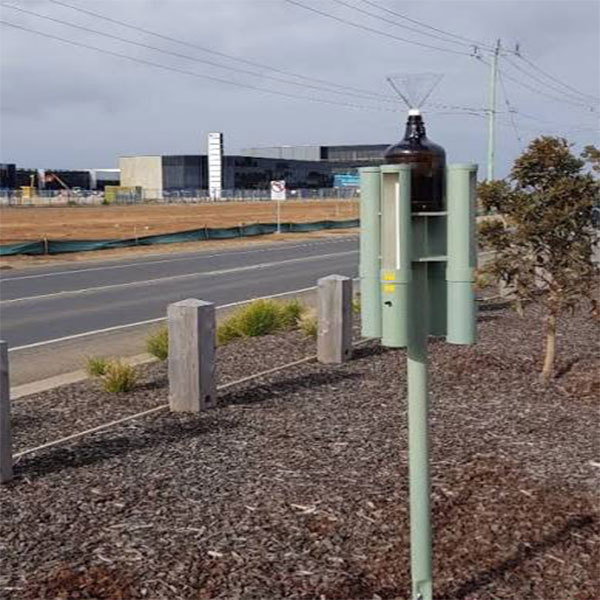
Directional dust deposition gauges provide a practical way to investigate where deposited dust is coming from and how dust is moving around an industrial or construction site. Unlike a conventional dust deposition gauge, which provides an overall measurement of deposited material at a monitoring location, a directional gauge separates the collected material into different compass directions. This allows monitoring programs to examine differences in dust loading from the north, south, east and west.
Directional monitoring can be particularly valuable where there are multiple potential dust sources, nearby sensitive receptors, or a need to distinguish between dust originating from a site and dust entering the site from surrounding areas.
How Directional Dust Gauges Work
A directional dust deposition gauge uses separate collection chambers positioned around the gauge to sample dust associated with different directions. The four collection sections are normally oriented to the cardinal directions:
- North
- South
- East
- West
As dust moves through the surrounding air, material is collected by the individual directional collectors. At the end of the monitoring period, each section can be recovered and analyzed separately. Comparing the results from the four directions provides additional information that cannot be obtained from a single standard deposition gauge. For example, a higher result in one directional collector may indicate a greater contribution of dust associated with activities or areas located in that direction.
Directional results can also be considered alongside wind and weather information to provide a more complete understanding of dust movement.
Why Use Directional Dust Monitoring?
A standard dust deposition gauge can establish how much material is being deposited at a particular monitoring point. However, it does not by itself indicate the direction from which that material arrived.
Directional monitoring adds another layer of information.
This can be useful when:
- Investigating potential sources of deposited dust.
- Assessing dust movement around a site boundary.
- Comparing upwind and downwind conditions.
- Investigating dust complaints.
- Assessing the influence of nearby industrial activities.
- Monitoring construction, earthworks or demolition activities.
- Evaluating dust-control measures.
- Establishing baseline conditions before or during a project.
- Supporting environmental investigations where several potential dust sources are present.
Directional Dust Monitoring in Australia
Directional dust gauges are used in Australia as part of environmental and dust-monitoring programs across industries including mining, quarrying, construction, waste management, manufacturing and other activities where deposited dust may need to be investigated. The exact monitoring requirements for a project will depend on the applicable environmental approval, license, development conditions, monitoring plan and requirements of the relevant Australian regulator.
For this reason, directional dust gauges should be incorporated into a monitoring program according to the applicable standards and project requirements rather than being treated as a standalone indicator of regulatory compliance.
Applications Across Industry
Directional dust deposition gauges can be useful in a wide range of Australian industrial and environmental applications.
Mining and Quarrying
Mining and quarrying operations can generate dust through extraction, crushing, screening, stockpiling, vehicle movements and material handling. Directional monitoring can help assess dust movement around operational boundaries and investigate potential contributions from different areas.
Construction and Infrastructure
Large construction and infrastructure projects can involve excavation, earthworks, demolition, material storage and vehicle movements. Directional gauges can supplement other monitoring methods by providing information about the distribution and direction of deposited dust.
Waste and Resource Recovery
Landfills, transfer stations and resource recovery facilities may have several potential sources of dust within or around a site. Directional monitoring can assist in identifying patterns in deposited dust and investigating potential off-site impacts.
Industrial Facilities
Manufacturing and processing facilities can use directional dust monitoring where raw materials, bulk handling, storage, processing or vehicle movements have the potential to contribute to local dust deposition.
Environmental Investigations
Environmental consultants and monitoring professionals can use directional gauges when an investigation requires more information than a conventional deposition gauge can provide.
Directional Gauges and Standard Dust Deposition Gauges
Directional and standard deposition gauges can be used together as complementary monitoring tools.
A standard dust deposition gauge provides an overall measure of deposited material at a monitoring location.
A directional dust gauge provides additional information about the distribution of collected material according to direction.
A Simple, Passive Monitoring Solution
Directional dust gauges are passive monitoring devices and do not require electrical power or continuous data transmission. This makes them suitable for fixed monitoring locations where samples can be collected periodically and submitted for laboratory analysis. Their relatively simple design also allows multiple monitoring locations to be established around a site, providing a broader picture of dust movement and deposition.
Directional Dust Deposition Gauges for Australian Monitoring Programs
We supply directional dust deposition gauges for environmental monitoring applications across Australia. Our gauges provide monitoring teams with a practical way to collect directional dust samples for subsequent analysis and assessment. They can be incorporated into monitoring programs for industrial sites, construction projects, mining and quarry operations, waste facilities and other activities where understanding dust movement is important.
Need directional dust monitoring equipment for your project?
Contact our team to discuss your monitoring requirements and determine the appropriate gauge configuration for your application.