Description
Dust deposition gauges provide a simple, proven method for monitoring the amount of particulate matter settling from the atmosphere onto a defined collection area over a measured period. Used extensively for environmental monitoring and dust management, deposition gauges help industry assess dust impacts, identify trends and demonstrate that appropriate dust-control measures are being implemented. Our dust deposition gauges are designed for use in environmental monitoring programs where sampling is undertaken in accordance with relevant Australian Standards and regulatory requirements.
How Do Dust Deposition Gauges Work?
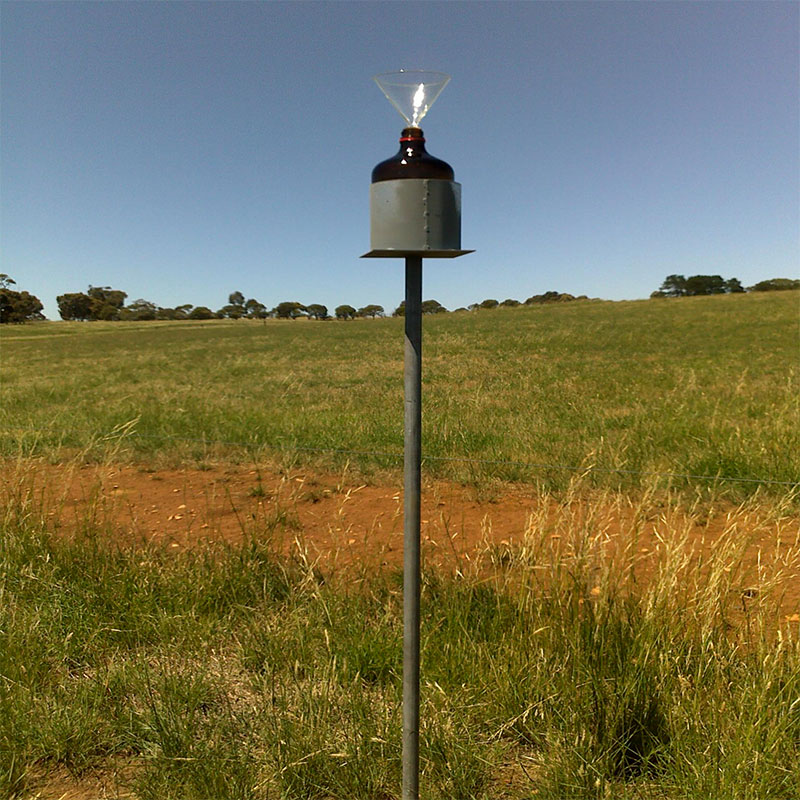
A dust deposition gauge collects airborne particles that settle naturally from the atmosphere. The gauge typically consists of a collection funnel and container mounted securely at a suitable monitoring location. During the monitoring period, dust and other deposited material are collected in the container. At the end of the sampling period, the sample is recovered and analysed to determine the amount of deposited material over the exposure period.
Australian Standards & Environmental Compliance
Dust deposition monitoring in Australia is commonly undertaken with reference to AS 3580.10.1, which covers the determination of deposited matter using dust deposition gauges. The appropriate monitoring method, sampling frequency, locations and assessment criteria will depend on the applicable environmental license, approval, project requirements and jurisdiction.
Australian Standards can also be incorporated into regulatory requirements, making it important to refer to the current applicable standard and relevant regulatory requirements when establishing a monitoring program. Our gauges provide industry with a practical sampling solution for environmental monitoring programs where consistent, repeatable dust deposition measurements are required.
Applications Across Industry
Dust deposition gauges are used across a wide range of industries and projects where deposited dust needs to be monitored, including:
- Quarries and extractive industries – monitoring dust deposition around operational boundaries and sensitive receptors.
- Mining operations – assessing deposited dust associated with mining, stockpiles, haul roads and material handling.
- Construction and infrastructure projects – monitoring dust impacts during earthworks, demolition and major construction activities.
- Waste and resource recovery facilities – assessing potential off-site dust impacts.
- Manufacturing and processing facilities – monitoring dust deposition around industrial premises.
- Ports, terminals and bulk-material handling facilities – monitoring dust associated with loading, unloading, storage and transport.
- Landfills and transfer stations – supporting environmental monitoring and dust-management programs.
- Environmental consultants – providing a straightforward sampling method for ongoing monitoring programs and compliance reporting.
Supporting Effective Dust Management
Dust deposition monitoring can provide valuable information about how dust is moving around a site and whether existing control measures are effective. By establishing monitoring locations around a site boundary or at other relevant receptor locations, operators can compare deposition results over time and identify changes associated with site activities, weather conditions or changes to dust-control measures. Monitoring results can help businesses:
- Identify potential sources and patterns of deposited dust.
- Establish baseline conditions.
- Monitor changes over time.
- Investigate potential dust impacts and complaints.
- Assess the effectiveness of dust suppression and management measures.
- Support environmental management plans and reporting.
- Provide documented monitoring data for regulatory and project requirements.
A Practical Solution for Environmental Monitoring
Dust deposition gauges offer a low-maintenance and cost-effective approach to long-term dust monitoring. They require no electrical power or continuous data connection, making them suitable for remote monitoring locations and distributed monitoring networks. When correctly installed, exposed, recovered and analysed in accordance with the applicable monitoring method, deposition gauges can provide consistent data to support environmental decision-making and dust-management programs.
Looking for dust deposition gauges for your next monitoring program?
Contact our team to discuss your requirements and select the appropriate gauge configuration for your application.