Description
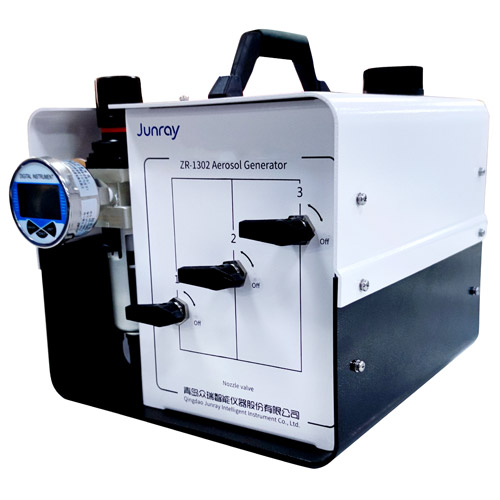
The Junray ZR-1302 is a professional portable aerosol generator for generating DOP, PAO and other aerosols via a Laskin nozzle. The embedded adjusting valve can control the operation of between 1 to 3 nozzles. When the air flow is 2.3 m3/min – 230 m3/min, the output aerosol concentration is 10μg/L – 100μg/L. Designed for testing filter systems from small glove boxes to large cleanroom plenums, the Junray ZR-1302 is the ideal solution for creating a poly disperse sub-micron aerosol to certify and qualify HEPA filter systems.
The Junray ZR-1302 aerosol generator is suitable for HEPA filter testing in a wide variety of industries (medical device testing, centers of disease control, hospitals, pharmaceutical companies, HEPA filter manufacturers, testing and certification companies and many others. This specific model requires an external compressor.
Key Features
- 0 to 1,000 kPa working pressure gauge range
- This is a higher concentration version of the Junray ZR-1300A aerosol generator
- Adjustable aerosol concentration output for use in many different applications
- Particle concentration: 100μg/L (air flow is 23 m3/min)
- Particle concentration: 10μg/L (air flow is 230 m3/min) or 2.3 g/min.
- 1.4 – 230 m3/min air volume
- Generate multiple kinds of aerosols, DOP, PAO and others
- Integrated passive pressure relief valve for increased safety
- 1,500mL oil loading
- Requires an external compressor
- External compressed gas (85 – 510) LPM, 140kPa
- 1 to 3 built-in adjustable Lazkin nozzles
- Includes an ILAC factory calibration certificate
- Weight: Approximately 7Kg
Standards
- ISO 14644-3
- NSF/ANSI 49-2019
The Junray ZR-1302 is manufactured by ISO 17025 accredited Junray based in Asia. Junray is a world leading manufacturer of aerosol photometers, particle counters and many other scientific and environmental monitoring instruments.

Junray ZR-1302
The Junray ZR-1302 aerosol generator belongs to a family of professional Laskin-nozzle aerosol generators designed primarily for HEPA filter and cleanroom integrity testing. These instruments generate a controlled aerosol, commonly substances like DOP, PAO, or similar oils, by forcing compressed air through multiple nozzles to create a stable cloud of fine particles. This aerosol is then measured downstream using an aerosol photometer to detect leaks in filtration systems, making the device widely used in hospitals, pharmaceutical manufacturing, biosafety cabinets, for HEPA filtered vacuum cleaner testing and certification labs.